
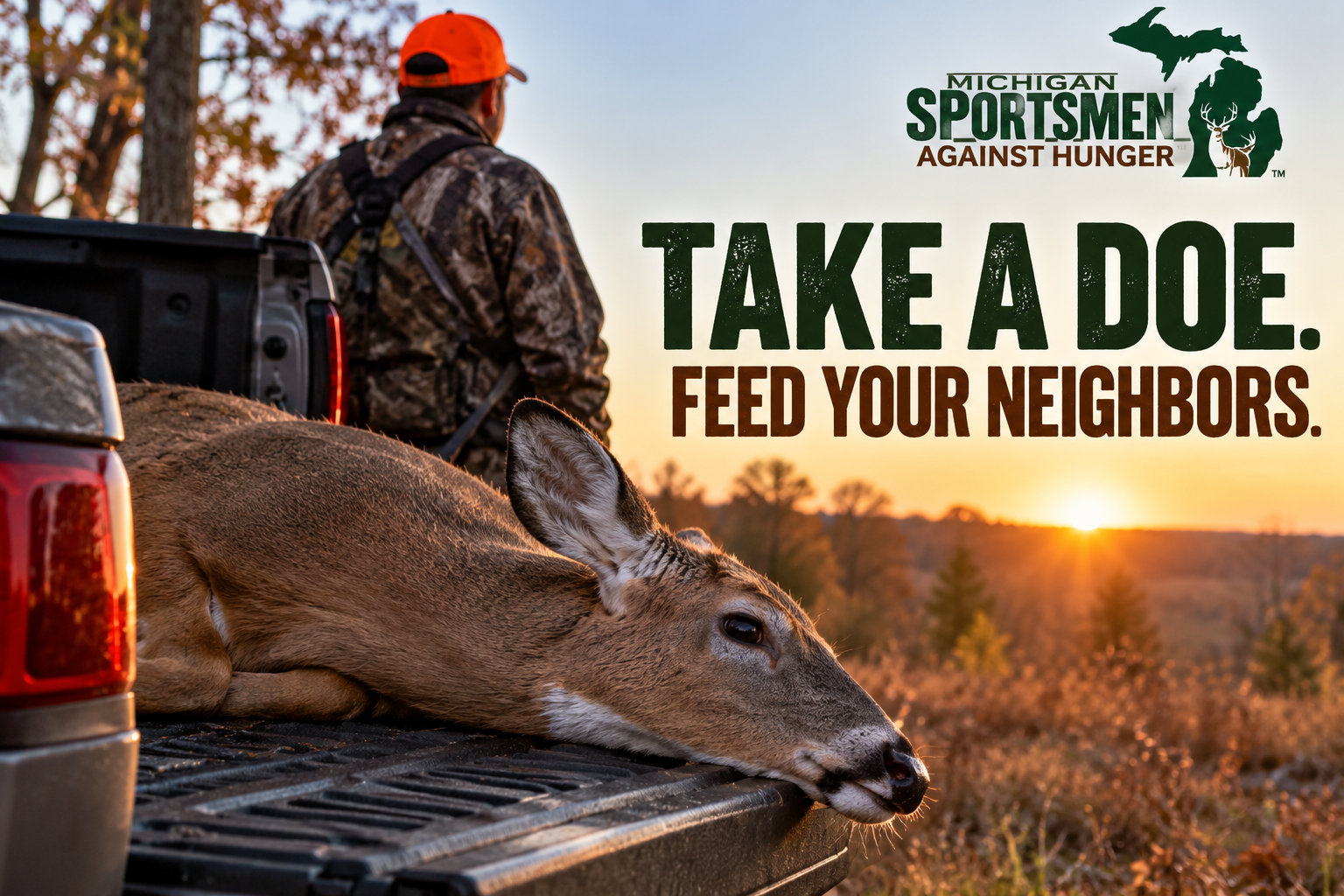
Take a Doe. Feed Your Neighbors.
For a lot of Michigan deer hunters, the season starts with a buck in mind.
We study trail-camera pictures. We watch scrapes. We wait on the right wind. We spend hours in the stand hoping that buck we’ve been watching finally makes a mistake.
But sometimes one of the most meaningful deer we can take doesn’t have antlers.
This fall, consider taking a doe — and donating her to help feed your neighbors.
Doe Harvest Is Part of Deer Management
Hunters play an important role in managing Michigan’s deer herd.
The Michigan Department of Natural Resources identifies hunting as the primary tool for managing the size and distribution of the state’s deer population. Antlerless harvest is an important part of that management strategy in areas where deer numbers support it.
And those conditions aren’t the same everywhere.
Some areas of Michigan have higher deer densities and more opportunities for antlerless harvest than others. Hunters should always understand the regulations and deer-management goals where they hunt.
But where additional doe harvest is appropriate, hunters have an opportunity to do something particularly valuable with that deer.
Instead of asking:
“What am I going to do with another deer?”
There’s another question worth asking:
“Who could use it?”
Turn That Doe Into Food
That’s where Michigan Sportsmen Against Hunger comes in.
Hunters can donate a legally harvested whole deer through a participating MSAH processor at no processing cost to the hunter.
The processor turns that deer into professionally packaged ground venison, and that meat is distributed through food banks, food pantries and other hunger-relief organizations serving Michigan families.
A typical donated deer provides approximately 40 pounds of ground venison — about 160 servings.
Think about what that means.
One doe.
One successful hunt.
And roughly 160 servings of high-quality protein headed to people who can use it.
From the Woods to a Neighbor’s Table
One of the things we value most about this program is how local the impact can be.
A deer harvested in a Michigan woodlot, farm field or swamp can be taken to a participating processor nearby.
That processor is part of the community.
The venison can then move to hunger-relief organizations serving families in Michigan communities.
Hunters provide the resource.
Processors provide their skill and labor.
Donors and sponsors help cover the processing cost.
Food pantries and partner organizations put the venison into the hands of people who need it.
It is a simple chain, but every part of it matters.
Maybe Your Family Already Has Enough
Plenty of us hunt because we want venison in our own freezers.
That should never be minimized. Providing food for our families is one of the best parts of hunting.
But eventually, the freezer gets full.
Maybe you’ve already taken a deer this year.
Maybe you still have venison from last season.
Or maybe you simply have an opportunity to harvest another doe in an area where additional antlerless harvest makes sense.
That doesn’t have to be the end of your season.
Make the next one a donation deer.
You can keep hunting, contribute to responsible deer management and turn that opportunity into food for another Michigan family.
Make the Decision Before You Climb Into the Stand
If donating a doe is something you’re willing to do this season, make the plan now.
Find a participating Michigan Sportsmen Against Hunger processor near the area you hunt.
Save their phone number.
Call ahead to verify their hours, capacity and donation procedures.
Then go hunting.
If the right opportunity comes along, you won’t be trying to figure out what to do with a deer after it’s already in the truck.
You’ll already know where it’s going.
Take a Doe. Feed Your Neighbors.
There are plenty of reasons we hunt.
Tradition.
Time outdoors.
Conservation.
Deer management.
Putting food on our own tables.
A donated deer brings all of those things together while adding one more:
Helping someone else put food on theirs.
So if the deer numbers, regulations and conditions where you hunt support taking an antlerless deer this fall, consider making one of those does a donation deer.
Take a doe.
Feed your neighbors.
And make one more hunt this season matter long after you leave the woods.
Find a Participating Processor
Michigan Sportsmen Against Hunger works with participating wild-game processors across Michigan.
Find a processor near where you hunt, call ahead, and make your donation plan before your next sit.
Find a Participating Processor →
Help Cover the Cost of a Donated Deer
Not everyone can donate a deer, but everyone can help put donated venison on a Michigan family’s table.
Financial contributions help Michigan Sportsmen Against Hunger reimburse participating processors and keep whole-deer donation free for hunters.
Support Michigan Sportsmen Against Hunger →